
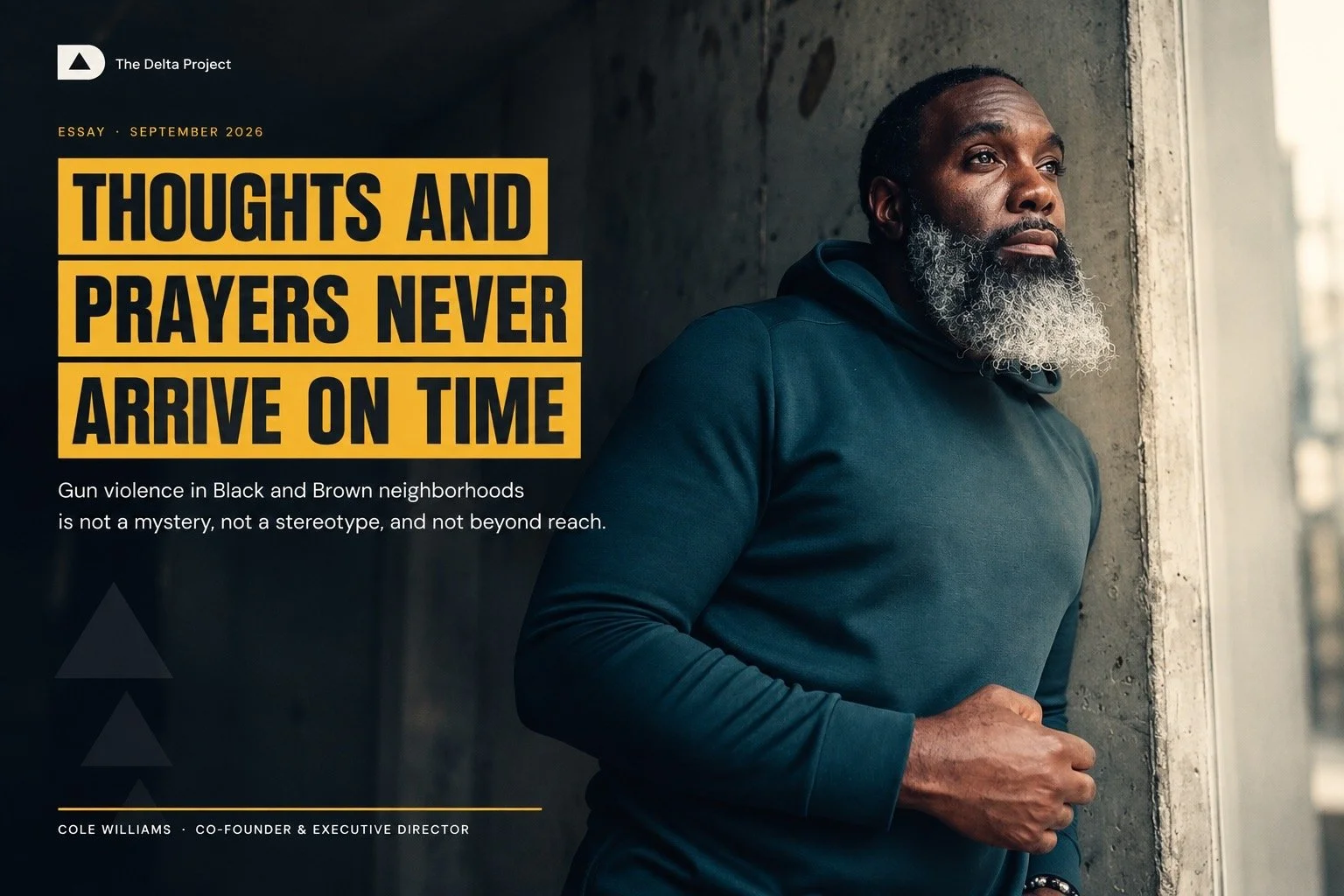
Thoughts and Prayers Never Arrive On Time
Grand Rapids lost more people this summer. The causes are harder than anyone wants them to be, and we already know most of them.
By Cole Williams, Executive Director and Co-Founder, The Delta Project
I lost someone last week.
I am not going to write about him at length. He deserves better than becoming an argument. I am writing this because I have run out of patience with the distance between how often this happens and how little moves when it does.
This is not a hypothetical for me. It is a Tuesday.
What This Summer Actually Looked Like
Seven deadly shootings hit the greater Grand Rapids area inside a matter of weeks. John Edward Garner III, 18, died Sunday night in a house on Sherman Street SE. Alexander Jones, 39, was found shot outside an apartment building on Marshall Street less than three days later. Since July 20, two more people were killed inside the city and three more in Wyoming and Gaines Township. On the south side, the one part of this town outpacing its own annual averages for both fatal and nonfatal shootings, seven people have been killed this year against a yearly average of two.
In May, a 15-year-old named Jeremiah Cuevas-Griffin was shot on the grounds of Southwest Elementary while he played soccer. Savanah Villarreal, 39, a mother of eight, was killed trying to reach him. Police say the person charged in their deaths had asked to join the game and been turned away. He was 18 years old.
In 2024, 15-year-old Amillier Penn was killed on Umatilla Street on the southeast side, playing football with his friends. A year later, 17-year-old Niles Murray was shot and killed a few feet from Penn’s memorial on that same street, at a gathering held on what would have been Penn’s 17th birthday. Investigators counted somewhere between fifty and a hundred casings. Grand Rapids Police Chief Eric Winstrom said the obvious thing that night:
“We have got to do better as a city.”
He also said he did not know what else to say. I know what to say. The trouble is that saying it honestly means refusing every easy version of the story.
T H E E A S Y V E R S I O N I S A L I E
The easy version says these young men are broken. The easy version says the neighborhood is broken. The easy version arrives in the comments under every one of those headlines within about forty minutes, and it costs the person typing it nothing.
Community gun violence is not spread evenly across a city, and it is not spread evenly across the people who live in that city. In Chicago, close to 70 percent of shootings occurred inside social networks making up less than 6 percent of the population. In Boston, half of all shootings happened on under 3 percent of the city’s streets. In Oakland, roughly a tenth of a percent of residents were tied to most of the homicides. Across multiple American cities, under 1 percent of a city’s population is connected to at least half of the violent incidents. If someone in your immediate social network has been killed, your own odds of dying by homicide climb by roughly 900 percent.
The finding cuts both directions. This violence is not random, not cultural, and not a fixed property of Black and Brown people. It is small, traceable, and clustered. A handful of blocks and a handful of relationships drive most of the harm.
Which means it is reachable.
A reachable problem creates an obligation. A cultural problem lets you shake your head and change the channel.
Michigan
Michigan recorded 1,384 gun deaths in 2023: 518 homicides, 836 suicides. Seventy-five of the dead were children and teenagers between the ages of 1 and 17. Firearms were the leading cause of death for that age group in this state. Somebody in Michigan is killed by a gun roughly every six hours, and our overall gun death rate climbed 25 percent between 2014 and 2023.
Young Black men between 15 and 34 make up about 2 percent of Michigan’s population. In 2023 they accounted for 42 percent of every gun homicide death in the state.
Two percent of the people. Forty-two percent of the dying.
Michigan has taken action. In 2023 the state passed universal background checks, a secure storage requirement for homes where minors are present, extreme risk protection orders, and a firearm prohibition for people convicted of domestic violence misdemeanors. Those laws took effect in February 2024. They were hard-won and they matter. But a law that no one in my neighborhood has heard of is a law that does not work here. Implementation is not a press release. It is outreach, funding, training, and follow-through in the specific census tracts where the shootings are happening.
The Country
Nationally, homicide was the number one cause of death for Black youth and young adults ages 10 to 24 in 2023. Black Americans were 13.7 percent of the population and 53.8 percent of homicide victims. In the twenty largest counties in this country, Black men between 15 and 24 die by gun homicide at close to 23 times the rate of white residents their same age.
In 2024, more Black men ages 15 to 24 died in gun homicides than died from unintentional injury, suicide, heart disease, cancer, non-firearm homicide, diabetes, congenital conditions, chronic respiratory disease, police shootings, stroke, sepsis, influenza, pneumonia, and HIV combined.
Every single one of those other causes has a foundation, a ribbon, a race, a research pipeline, a month on the calendar.
What A statistic cannot hold
In a recent local conversation about gun violence, the question came up of whether this community was actually seeing an increase in homicides. The response focused on the data, which did not necessarily show the dramatic increase that public perception might suggest.
That was a fair reading of the numbers, and I have just spent three sections of this piece arguing with numbers, so I am not going to pretend they do not matter. But a statistic is an instrument built to answer one narrow question, which is whether this year resembles last year. It was never built to answer whether a community is alright. We keep letting the first question impersonate the second.
That conversation stayed with me because of what statistics cannot capture. When even one young person is murdered, a community grieves the life that was lost and the future that disappeared with it. One murdered young person is not one number added to a data set. It is a family that will grieve for the rest of its life. It is a child who may now grow up without a father. It is a block, a school, and a group of friends carrying trauma that nobody will ever screen them for.
The impact on children, families, neighborhoods, and everyone who loved that young person cannot be measured by whether the homicide rate went up or down. Joseph Lawrence Ivory Jr. was 16 when he was shot and killed on the southeast side about two minutes into 2023, the first person this city lost to gun violence that year. Everyone called him Jo Jo. He was a student at Ottawa Hills. He had recently come off probation. He had a ten-month-old son. When his family handed photographs to the news station, the pictures they chose were of him holding that baby.
In the annual count, Jo Jo is a one. On the southeast side, he is a boy who was trying to be a father before he was old enough to drive, and a son who is now old enough to start asking about the man in those photographs. Nearly four years on, Jo Jo’s own father is still asking why. There is no column for that, and there is no column for the fact that these young men were never statistics to the people who raised them.
Selective Empathy
The numbers above have been true my entire adult life without producing a national emergency. There is a reason for that, and it is not complicated.
When violence arrives in a place the country has decided is innocent, it becomes a story about all of us. There are vigils on national television. There are policy hearings. There are anniversaries observed years later by people who never met the dead. When it arrives on Sherman Street, it becomes weather. It gets a ninety-second segment, a police contact number, a request for tips. Then it recedes, and the next one takes its place, and the fact that a 15-year-old was shot playing soccer on an elementary school field in the middle of Grand Rapids does not reorganize a single institution’s priorities.
This is not a claim about who grieves harder. Families here grieve the way families anywhere grieve. It is a claim about which grief converts into money, legislation, and staying power. Ours converts at a discount, and everybody who works in this field knows it.
Selective empathy is not a feeling. It is a budget line.
Thoughts and prayers never arrive on time
I say that as a man of faith. I pray. I have prayed over caskets I helped carry.
But prayer was never designed to substitute for a funded violence interruption team, a job that pays, a school that does not push a 14-year-old out the door, or an attorney standing next to a kid in a courtroom. When we offer thoughts and prayers as the whole response, we are not being spiritual. We are being cheap, and we are being cheap specifically about children whose deaths we have already decided are ordinary.
In April 2025 the Department of Justice abruptly terminated roughly $500 million in grants across more than 200 organizations working on safety and justice. Community violence intervention programs were gutted. At least one twenty-year-old national organization closed permanently within weeks. The proposed federal budget for 2026 eliminates the Community Violence Intervention and Prevention Initiative outright. The CDC’s system for tracking nonfatal firearm injuries is being eliminated as well, which means we are choosing not to know.
This happened while homicides across 35 major American cities fell 21 percent in a single year, which is 922 people who came home. We defunded the thing at the exact moment it was working.
What Bolder actually looks like
Bolder is not a hashtag. It is five specific commitments, and every one of them has an owner.
Fund the interrupters. Community violence intervention is not charity, and it is not soft. One recent study found program alumni were 73 percent less likely to be arrested for a violent crime in the two years after enrollment. Michigan’s budget already carries CVI funding. It needs to be permanent, multi-year, and routed to organizations with credibility on the specific blocks that are driving the numbers, not to whoever writes the strongest grant application.
Implement the laws we already passed. Secure storage, background checks, and extreme risk protection orders only save lives if the people closest to a crisis know these tools exist and know how to use them. That is a public education and training obligation that the state has not yet met at the neighborhood level.
Put counsel next to every young person. Michigan Senate Bill 81 would guarantee a young person’s right to an attorney in the juvenile system. A child alone in a courtroom is how a bad week becomes a permanent record, and a permanent record is one of the most reliable on-ramps into the exact networks this violence travels through.
Invest before the trigger, not after. The evidence on this is a decade old and stubborn. Summer employment programs, cognitive behavioral therapy delivered in schools, real mentorship at scale. Chicago’s One Summer Plus study found violent-crime arrests among participants fell sharply, and the effect persisted long after the paychecks stopped. We know this works, and we fund it like a pilot.
Change what a life is worth in the coverage. Editors, funders, and elected officials can audit their own year. Count what a death on the south side received against what a death somewhere else received. The gap between those two numbers is a policy, whether or not anyone meant to write it.
What Is Owed
The young man I lost last week was not a statistic and he was not a warning. He was somebody’s. He was ours.
Jo Jo. Amillier Penn. Niles Murray. Jeremiah Cuevas-Griffin. Savanah Villarreal. Their memory is not only our ongoing memorial. It is our continued mission.
I run an organization built on a question I have asked young men for years: What does it mean to become something you have never seen? I ask it because imagination is the first thing this violence takes. Before it takes a life, it takes the ability to picture one.
Every young man I work with can describe his own funeral. Very few can describe himself at 30.
That is the injury. That is what the numbers in this piece are actually measuring. And it will not be fixed by anyone’s grief, including mine.
It will be fixed by money, by law, by presence, and by a country that decides our children were always worth the same emergency response as everybody else’s.
We are still waiting on that decision. We have been waiting the whole time.