
The Curriculum in the Chair
In Lansing, a barber’s chair has become one of the most honest rooms a young man can sit in. The framework guiding those conversations is one The Delta Project wrote.
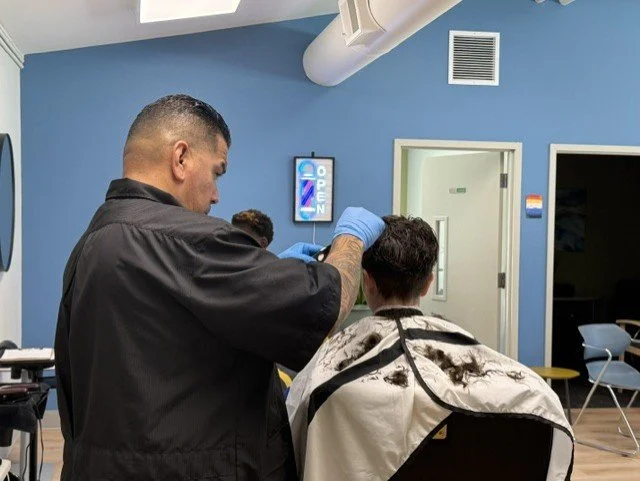
A young man getting his haircut and being mentored at the same time.
There is a reason a young man will tell his barber what he won’t tell almost anyone else.
For thirty or forty-five minutes, he is sitting still. Someone he trusts has his full attention.
There is no performance to keep up, no crowd to answer to. Just the sound of the clippers and a person who has, sometimes, known him since he was small enough to need a booster seat in the chair.
In a lot of communities, the barbershop is the one place a young man’s guard comes down. That is not a small thing. For boys taught to carry their weight in silence, it can be the difference between a feeling that gets spoken and one that gets buried.
Lansing is leaning into that truth. This June, News 10 reported on Barbershop Talk, a series run by Child and Family Charities out of its Dart Youth Education and Drop-in Center.
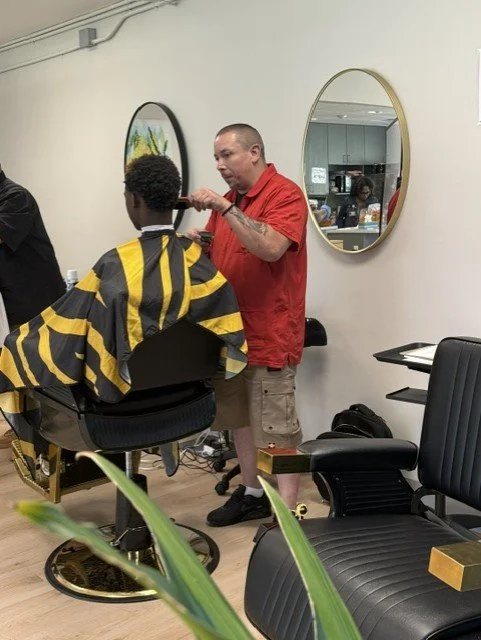
Another young man is getting a haircut while having candid conversations
Twice a month, young people between 14 and 21 come in for a free professional haircut and an open conversation — led by trusted adults — about the things that usually go unspoken: gun violence, suicide, fatherhood. One barber in the story described how the relationship deepens with every visit, and how that trust is what finally lets a young man talk. A 17-year-old participant said the sessions help him get things off his chest and help the young men who hear him do the same.
What the reporting captured was the room. What it didn’t name was the framework making those conversations possible.
The curriculum being used to support those young men and their mental health is Son to a Father, written by Cole Williams for The Delta Project. It was built for exactly this moment around the questions young men so rarely get to ask out loud: about masculinity and the versions of it they’ve inherited, about fatherhood and its absence, about the weight they carry and where they’re allowed to set it down, about what it takes to become something you have never seen modeled. It is not a worksheet, and it is not a lecture. It is a set of doors, opened in the right order, by someone a young man already trusts.
That is why the barbershop is the perfect room for it. Son to a Father does not work by
cornering a young man with a program. It works by giving a credible messenger a barber with clippers in his hand and a young man’s confidence they’ve already earned, and the language to go somewhere real.
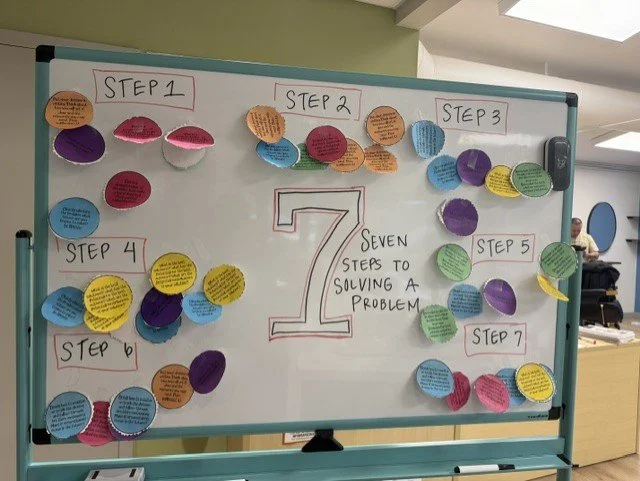
Part of the workshop for problem solving.
The chair becomes the classroom. The haircut becomes the reason he came, and the conversation becomes the reason he comes back. The curriculum lands precisely because it never announces itself as one.
None of this is a hunch. The most-cited barbershop health study in the country — a Cedars-Sinai trial published in the New England Journal of Medicine — proved that Black men reached in the barber’s chair got results the clinic could not touch, lowering blood pressure so sharply that the shop outperformed the doctor’s office.
Researchers have spent years documenting what the community already knew: the barbershop is where Black men actually show up, actually talk, and actually trust. And the field’s own reviews now point past physical health to the next frontier -- mental health for young men, delivered by the people they already rely on. That is the gap Son to a Father steps into. Cole Williams did not follow that research. He was already there.
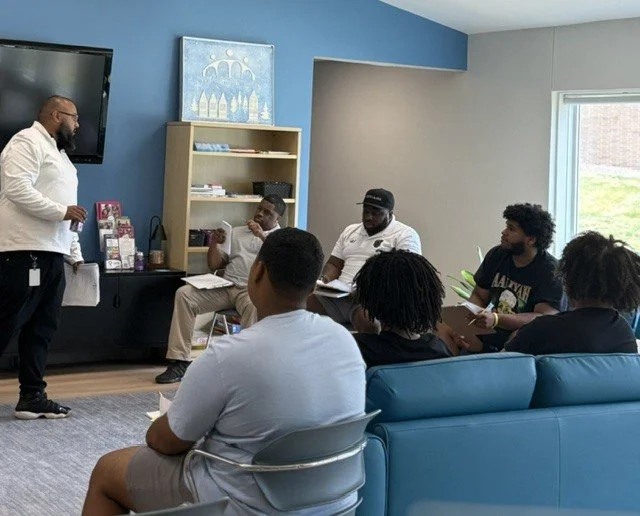
Working through the program with young people
The Delta Project has staked its work on the idea that belonging is the intervention. The systems that are supposed to catch young men often reach them too late and too formally. Another assembly, another flyer, another adult talking at them instead of with them. A haircut reaches them early, and on their own terms. A trusted adult who has earned the right to ask, “how are you, really?” does more than any mandate. Put a curriculum like Son to a Father in that adult’s hands, and the chair stops being just a chair. It becomes one of the few places a young man is met with substance, experience, compassion, and support all at once.
Cole Williams built Son to a Father to travel. So it can work in the rooms where young men already are, rather than the ones we wish they’d walk into. In Lansing, it is doing exactly that. The reporting told the story of the chair. This is the story of what’s being said in it, and why it matters that someone finally wrote it down.
That’s the whole curriculum, really. The rest is just technique.